Posts

CB&Q Suburban Coaches
Image
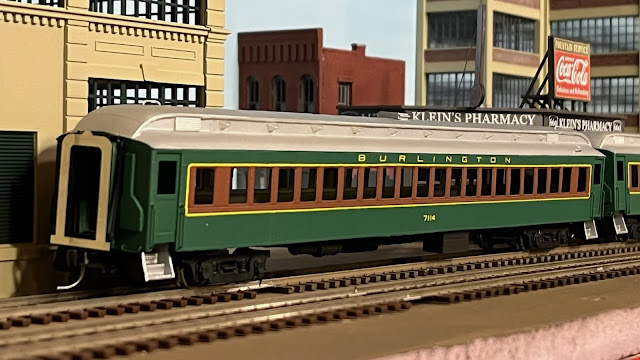
The Burlington operated extensive commuter service on the “racetrack” out of Chicago Union Station. The volume of trains was one of the reasons three tracks were needed as far west as Aurora. The late 40’s - early 50’s were a time of transition when the Burlington extensively modernized its fleet of suburban equipment. Going into this period, the backbone of the fleet was made up of steel open platform coaches built in the 1920s. In 1949, the Burlington started to rebuild some of these with enclosed vestibules and air conditioning. This program coincided with the purchase of new stainless steel bi-level gallery cars that began arriving in 1950. Some of the former open platform coaches were converted into power cars to supply electricity to the new gallery cars. Lastly, several heavyweight long-distance coaches were also transferred to suburban service. This shuffling of equipment resulted in an interesting variety in suburban service that I wanted to model. This post will focus on the ...

CB&Q Solarium Observation

Image
I  stumbled across an ad for a Bethlehem Car Works heavyweight observation car kit that looked very similar to pictures I had seen of CB&Q prototypes with a two-window solarium section at the rear. It seemed perfect for my Exposition Flyer consist. After doing some research, I found these cars were modeled after a class used on CB&Q name trains like the Aristocrat and Black Hawk in the 20s and 30s. By the late 40s period that I model, they had been transferred to the Pennsylvania Railroad. I decided to use some modeler’s license as the CB&Q still had similar looking DL-3 lounges operating in the 40s. I was also curious to try out a BCW kit. The kit is a combination of resin sides and ends with a former Branchline heavyweight core and roof. There is a complete set of underbody details and Branchline trucks. A collection of other resin and plastic detail parts is included. I used a combination of these and 3rd-party details to better match the Burlington cars of the 1940’...

CB&Q F-1 0-8-0

Image
The  Burlington rostered 10 USRA design 0-8-0 locomotives in the F-1 class. They are one of the few classes of CB&Q steamers that can be accurately modeled from a mass-produced plastic model. On the whole, the CB&Q preferred 0-6-0s for most switching duties and had comparatively few 0-8-0s. The F-1 switchers were mainly used in the large classification yards such as Cicero, IL or Beardstown in Southern Illinois coal country. Several years ago, I purchased a Walthers Proto USRA 0-8-0 that was factory painted as CB&Q 542. The engine is very well detailed and is a quiet runner. It came with a QSI sound decoder that was a little….meh.    It ran fine and sounded okay. I used it on my home layout but never gave it any upgrades or improvements. Eventually the tinny chuff and generic whistle began to get on my nerves. With the first section of my new layout under construction, I was inspired to spiff up the 542 and do some switching on what will eventually become an i...

CB&Q FT-F2 Set Part 2

Image
The EMD F2 was a transition model and introduced the general architecture that carried on through the remainder of F-unit production all the way to the F9 of the mid 1950’s. Offered only for 5 months at the end of 1946, the F2 sported a revised carbody and improvements to the arrangement of internal components compared to the FT. Belt-driven radiator fans and traction motor blowers were replaced with electrically driven ones. The F2 used the same D8 main generator as the FT, which limited power output to the same 1,350hp. Development of a new generator coincided with the beginning of F3 production in December 1946. The Burlington’s 10 F2As were delivered in July 1946. They were ordered specifically to pair with FTA/B sets to make 3-unit 4050hp locomotives for use on trains where 4-unit sets were overpowered. Since the Burlington considered each set a single locomotive, road numbers were shared across the sets with letter suffixes to distinguish each unit (e.g. 150-A, -B, & -C)....

CB&Q FT-F2 Set Part 1

Image
Like many railroads, the CB&Q’s first road freight diesel was the EMD FT. They received 16 4-unit FT locomotives in 1943-44. The A-B-B-A sets were semi-permanently coupled and were considered single 5,400hp locomotives. In the immediate postwar years, 5 of the FT sets were broken up and paired with 10 F2 cab units built in 1946 to create 4050hp 3-unit F2A - FTB - FTA locomotives. The Burlington operated a large fleet of F units during the years I model, so I couldn’t resist having one of these uniquely Q sets on my layout. While models of the later F unit versions are plentiful, FT’s have only been made in plastic by Bachmann, Intermountain, and Stewart. (As of this writing, Rapido has also announced FTs.) The Bachmann FT is inaccurate as it uses the same chassis as a later-model F-unit and is too long as a result. The Intermountain offering would have been my first choice from a detail perspective, but they are out of production and very hard to find on the secondary market. Stewa...